


 (
(

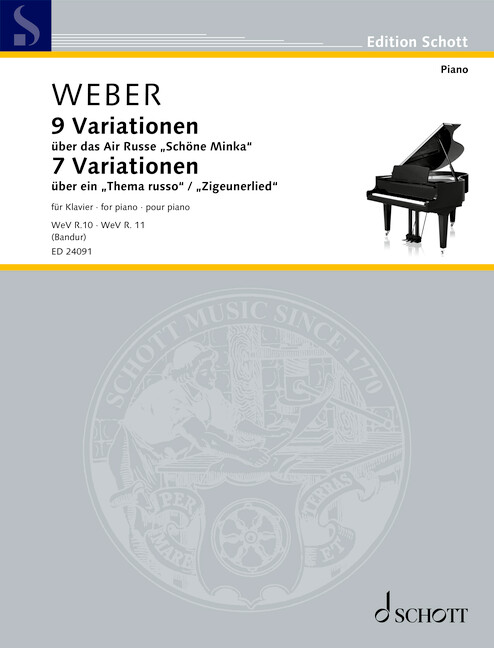
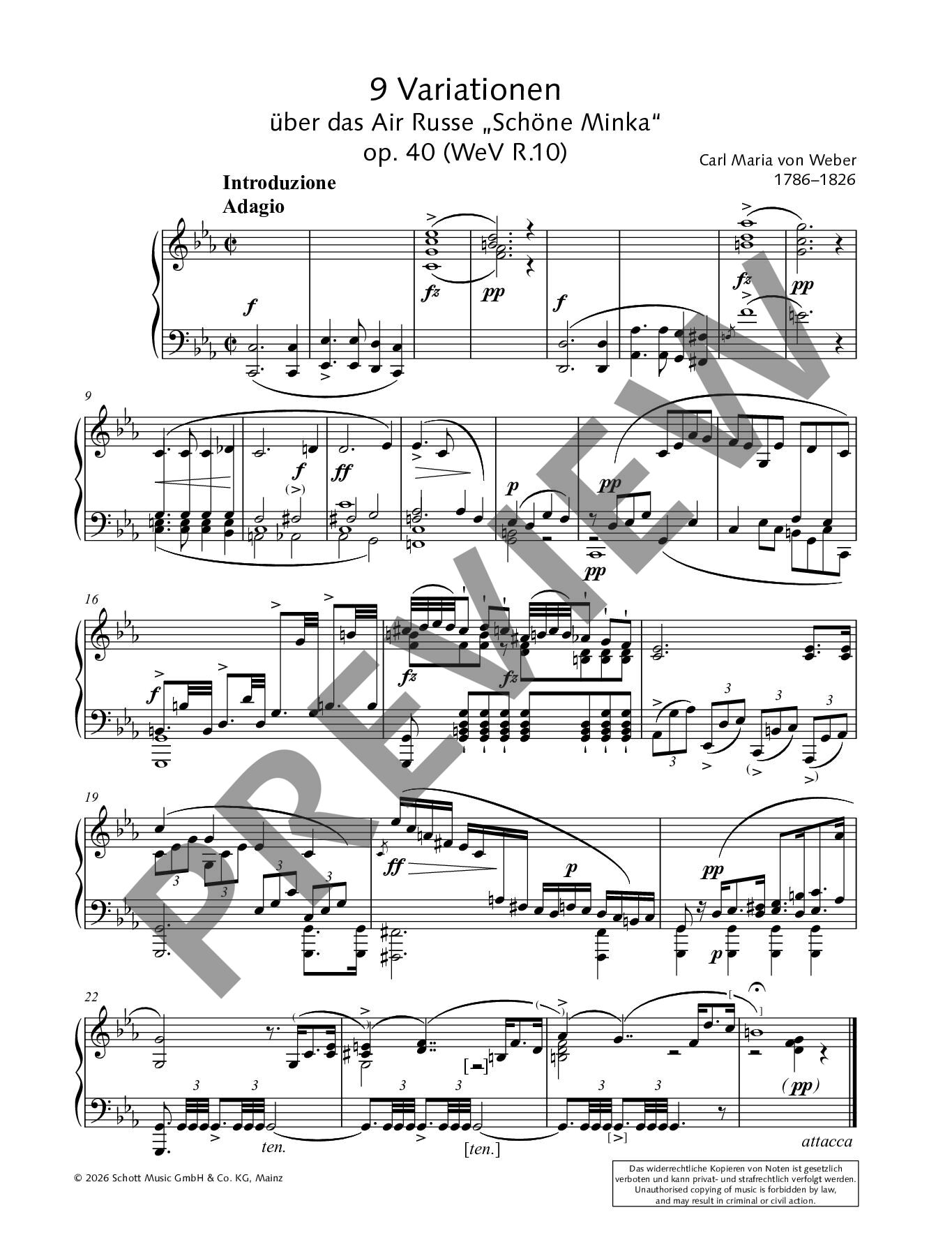
The theme of the 9 Variations on a Russian Theme, ‘Schöne Minka’, op. 40 (WeV R.10), composed in 1814–1815, is the song known as Air Russe, which begins with the German words ‘Schöne Minka, du mußt scheiden!’ (Beautiful Minka, you must depart!). Weber chose the melody of this tune in reference to the intended dedicatee, Maria Pavlovna, Grand Duchess of Saxe-Weimar-Eisenach, who was born in Pavlovsk near St Petersburg in 1786 as Grand Duchess of Russia. The origin of the song remains unclear, as does the question of which model Weber used as a basis for composing the cycle of variations. The song has been described in isolated cases in Russian-language specialist literature as a composition from the early 18th century in the Ukrainian-speaking region,1 but, given the growing interest in Russian folk tunes in Central and Western Europe at the end of the 18th century, it is entirely possible that the melody of ‘Minka’ did not originate in Russia at all and may simply be an imitation of Russian folk music. The earliest reference to his work on the variations can be found in Weber’s diary entry of 14 January 1814. In a letter dated 17 February 1814 from Prague to his Berlin publisher Schlesinger, Weber mentioned the variations, the publication of which was finally agreed upon in a contract dated 5 August 1814. Final work on the composition took place in March/April 1815. On 21 April 1815, Weber sent the corrected and supplemented dedication copy to Grand Duchess Maria Pavlovna with the dedication of the composition. Weber’s letter received no response from the Grand Duchess. The first edition appeared in the summer of 1815. A later anonymous review emphasised the work’s poetic style that went beyond its technical dimension: ‘The variations are based on the well-known “Beautiful Minka, I must depart” which varies a hundred times. But don’t think you’re buying something old, and only those who cooked up that watery soup should leave Weber untouched. To put this assurance beyond doubt, compare the first part of the theme according to the generally accepted tradition [music example] with Weber’s interpretation [music example: Thema, bb. 1–8 rH]. Of course, those who see only notes on the sheet of music will value this melody as much as the other. Others, however, will recognise in the fourth bar the softly yearning sixth, in the last bar its corresponding octave, the much more marked transition from the first to the second and from the fifth to the sixth bar, as well as from b to g (without the mediation of d) in the seventh bar as features of a true and deep feeling, and will gladly point out the poor movement in the first, third and fifth bars in the ordinary way, as well as the repetition of the second bar in the fourth. The theme is preceded by an introduction woven from the figures of the various variations, which prepares the listener for something very serious, even emotionally distressing, and therefore seems almost inappropriate to the reviewer. However, the impression is not so profound that one would forget it in favour of the natural, wistfully melancholy lament of the warrior bidding farewell to his beloved (theme). The purpose of the nine variations is to present this theme from a variety of perspectives. The first [music example: Var. 1, bars 1–3] is an expression of melancholy but calm reflection, which is threatened only once (at the beginning of the second part) by a violent surge. No. 2 follows, bowed under the blows and burdens of fate, and in the second bar of the second part [music example: Var. 2, bar 9f.] one believes one hears the cry of painful lamentation. Wildly storming, grinding with rage, [music example: Var. 3, bar 4] No. 3 presses on; in No. 4, three lamenting parts (imitating at the beginning) join the theme in the upper part, whereupon No. 5, in wild, warlike splendour, fights the pain rather than bearing it. No. 6 sounds mildly soothing (in major for the first time), like a greeting from afar to the homeland, which is carried on joyfully by friends. Nos. 7 and 8 are tragically intensified repetitions of Nos. 1 and 3 (in terms of meaning, not figures), but then No. 9 concludes like the strange tale of a distant, sun-drenched, adventurous land, where nature, as if by magic, has filled the air with golden singers, the groves with sweet echoes, and the soul with new fervour. This tone poem, endowed with all the powers of the happiest talent, skilfully executed with the artistry of a mature master, hovers over the whole as its conclusion, like a gloriously shimmering and fragrant crown of flowers. The performance […] requires a considerable degree of technical training. However, even the greatest skill will be insufficient if the player does not have the ability to understand the ingenious composer in every respect.’ 7 Variations on a ‘Thema Russo’ or ‘Gypsy Song’, op. 55 (WeV R.11), composed in 1817, was commissioned in August 1817. The commission was apparently conveyed to Weber in Dresden by General Karl von Watzdorf, who also collected the completed composition on 17 October and paid the agreed fee. Watzdorf was a general and diplomat who, in March 1816, was entrusted with the education of Princes Friedrich August (later Friedrich August II, King of Saxony), Clemens and Johann (later Johann I, King of Saxony) at the Dresden court. In connection with the commission, Weber received from Watzdorf a copy of a song by an unknown author with the lyrics ‘woy deń czułe woy deń Romałe Taki mire dziawena, Ty-chał mange kiraweł’. Whether Watzdorf also was the one to commission the work or merely served as the messenger for the commission has not yet been clarified, nor has the question of the song’s origin and the language of the lyrics, except for their apostrophisation in the 19th century as ‘authentic Gypsy’. The earliest reference to Weber’s work on this cycle of variations is his diary entry of 26 August 1817, in which he notes the completion of the composition. In a letter dated 30 August 1817 to his then fiancée Caroline Brandt, he mentions both the fee for this commission (10 ducats) and the necessity of accepting such commissions due to the impending wedding (he probably adopted Watzdorf’s view that the song given to him was a Polish theme): ‘[on 26 August] I composed the commissioned Variat: on a Polish theme, for which I will receive 10 #. A job I would not normally have taken on, but now the plates, bricklayers, locksmiths, etc. bring me to do all sorts of things.’ On 15 October 1817, he completed the fair copy of the composition; two days later, a copy was made and handed over to Watzdorf, and the agreed fee was paid. In November 1818, he approached Schlesinger about a publication, referring to it as a ‘Russian theme’ with a ‘low’ level of difficulty. The publisher accepted Weber’s offer and published the work in November 1819 under the title ‘Seven Variations on a Gypsy Song’. In 1824, an extremely favourable and detailed review of the work was published: ‘The […] variations are an ingenious sketch inspired by gypsy life. The writer soon envisions a moonlit forest glade in summer splendour, buzzing with night birds and glowing beetles, and in the middle, around a cheerful fire, a small horde – there, behind the white beech trunks, the graphic artist listens intently, pen in hand, while the whispering night wind teasingly blows the page around. – Sentimental, but free and bold, to the point of strangeness and crudeness, playing carefree, stubbornly asserting every whim, and yet again, out of good will and cunning, so pliant and refined, we see the son of freedom in the theme and the first variations. How lightly and airily the nymph of the forest trips and flutters in the third variation, so that in the end her brown father, heartily glad for his daughter, follows her – this dance of all limbs, this natural grace, this fantastic agility, you need not seek in the city halls! – Now the chorus is sung in No. 4, albeit a little wildly and crudely, in the manner of the night-time fellows. The quick-tempered women lead the way, the more stubborn men lag behind, each singing stubbornly on their own and in their own way. Even though the men join in later and deeper, it still sounds as if it were meant to be that way – and in fact it is a canon, first in the lower fifth and then in the octave. – Then (No. 5) Old Mother emerges from her dark cloak and speaks thoughtfully. Her dainty granddaughter nestles up to her soothingly and affectionately, and everyone praises her in hushed tones, so strangely moving is this image of piety. Now (No. 6) floats Grazioso, living up to his name; is he looking tenderly at the little one? The soles and arms of the brotherly companions rise wildly, and the chorus breaks into joyful song, interspersed with the clanging of cymbals.’
Composer/Author: Carl Maria von Weber
Editor: Markus Bandur
Instrumentation: piano
Format: PDF
Pages: 35
Brand: Schott Music
Similar items available in Piano
You might like these

Digital Download

Digital Download

Digital Download
Digital Download

Digital Download

Digital Download
Digital Download
Digital Download

Digital Download
Digital Download