


 (
(

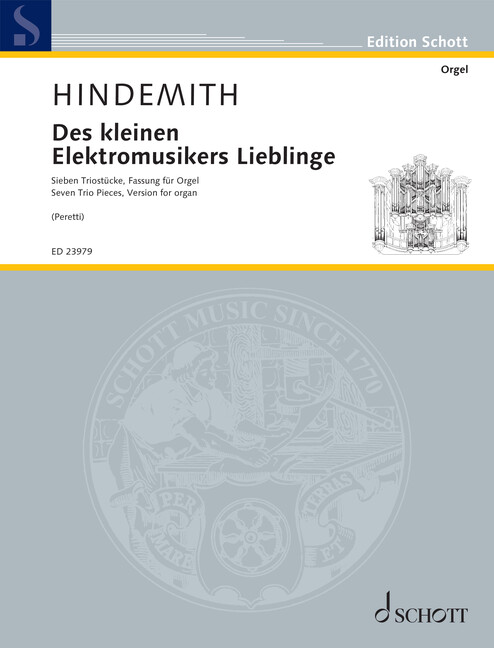
Paul Hindemith’s Sieben Stücke für drei Trautonien (‘Des kleinen Elektromusikers Lieblinge‘) was written in 1930 as the first of three works that the composer created for the trautonium invented by Friedrich Trautwein. The world premiere took place on the occasion of the presentation of the electronic instrument at the music festival Neue Musik Berlin on 20 June 1930; the performers were Hindemith himself, his composition student at the time Oskar Sala and the pianist Rudolph Schmidt. The seven trio pieces were not published until 1997, but with this edition they are now also available in an organ arrangement. This approach is obvious insofar as Friedrich Trautwein (himself an organist) had originally planned an electronic organ; in fact, the nasal tone characterised as ‘sharp’ in the 2nd and 7th pieces is very similar in sound to the organ stop Voix humaine. And the score markings Hauptwerk [great organ] and Fernwerk [echo organ], which refer to the placement of the loudspeakers at the performance venue, are borrowed from organ terminology. Despite the novelty of its sound production, the trautonium was well suited to Hindemith’s ‘linear counterpoint’, as can be seen in his compositions based on Baroque trio sonatas. The fact that the seven trio pieces were not intended to be overly instrument-specific is demonstrated by the composer’s later use of them – for example, in Plöner Musiktag (Trio Piece No. 3, as ‘Trio for String Instruments’) or in the fourth scene of the opera Mathis der Maler (Trio Piece No. 6 from bar 55, as ‘Wind Chorale’). The open Tristan quotation in the first piece has given rise to speculation. Playing this piece on the organ, however, requires considerable musical imagination, particularly with regard to the implementation and relativisation of the prescribed dynamics. Significant inspiration can be gained from Oskar Sala’s trautonium recording (made with the aid of multi-track technology) from 1977; from this ‘authentic’ interpretation comes the cadence of the second trautonium (= middle part) in Piece No. 6, which is only sketched out in Hindemith’s score. - Pier Damiano Peretti (Translation: Esther Dubielzig)
Composer/Author: Paul Hindemith
Instrumentation: organ
Format: PDF
Pages: 20
Brand: Schott Music
Similar items available in Organ
You might like these
Digital Download
Digital Download
Digital Download

Digital Download
Digital Download
Digital Download

Digital Download
Digital Download
Digital Download
Digital Download