


 (
(

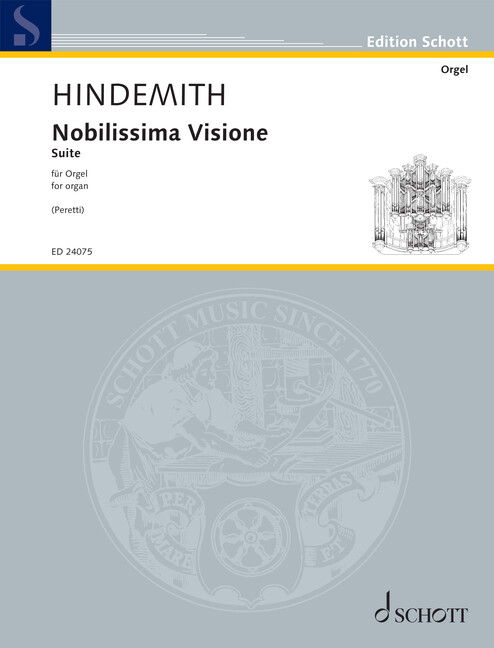
Paul Hindemith’s orchestral work Nobilissima Visione was created—as a ‘dance legend in six scenes’—in collaboration with the Russian-French choreographer Léonide Massine. In May 1937, they had visited the church of S. Croce in Florence together to see Giotto di Bondone’s (1267–1337) fresco cycle Storie di San Francesco. Under its impression, they developed the idea of a danced mystery play, which Massine later described as a ‘dramatic and choreographic representation of the life of Saint Francis’ that sought ‘to create and capture an atmosphere of mystical elevation’. The final movement, a passacaglia, symbolises the saint’s ‘Canticle to the Sun’, preserved only in textual form. The fifty-minute ballet was presented in London in July 1938; in the same year Hindemith compiled a selection of five out of the original eleven movements which were first performed as an orchestral suite in Venice in September 1938. It is in this version that the work has entered the orchestral repertoire; it is also the basis of the present arrangement. The idea of an organ transcription was inspired not only by the purpose and objective of the work, which may be understood in the broadest sense as ‘sacred’. Above all, it is the stylistic characteristics inherent in it, typical of Hindemith’s neoclassicism (Baroque formal models, linear writing andchurch-modal melody), that predestine it for such a transcription; they likewise shape the Organ Sonatas I and II, composed at the same time. The linear orchestral setting of Nobilissima Visione also conforms to that polyphonic ideal, deriving from the age of the basso continuo, which the composer described at the same time in The Craft of Musical Composition: “In both the contrapuntal and chordal idioms,harmonic development, which is tied to melodic movement, takes place within an external spatial frame—a skeleton which gives the chords the necessary contour. This framework is constructed by the bass voice and the most important of the upper voices. […] If writing in several voices is to sound clear and intelligible, the contours of its two-voice framework must be cleanly designed and cogently organized.” The arrangement process was guided by this principle. The aim was to create an organ setting that was largely idiomatic and based on Hindemith’s ‘contours’. In addition to the orchestral score, the piano reduction prepared by the composer in 1938 was consulted as well. The indicated organ registrations refer to an ideal, medium-sized three-manual instrument (I. Great, II. Positive, III. Swell); the choice of colours, modelled on the original instrumentation, is intended merely for guidance. - Pier Damiano Peretti (Translation: Esther Dubielzig)
Composer/Author: Paul Hindemith
Instrumentation: organ
Format: PDF
Pages: 50
Brand: Schott Music
Similar items available in Organ
You might like these
Digital Download

Digital Download
Digital Download

Digital Download
Digital Download
Digital Download
Digital Download
Digital Download
Digital Download
Digital Download